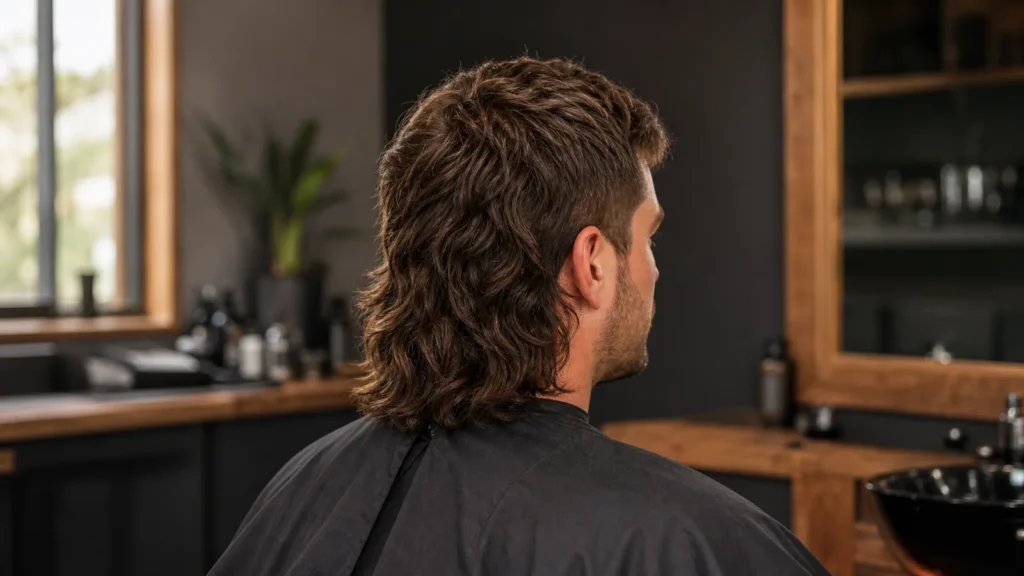
A mullet is a haircut with clearly more length at the back than at the sides. The front and top may be short, long, blunt, layered, curly or swept; the back-to-side contrast is what makes it a mullet.
Common mullet styles
| Style | Shape | Best starting point |
|---|---|---|
| Classic mullet | Shorter top and sides, pronounced longer back | At least several centimetres at the nape |
| Modern mullet | Textured top, layered back, softer connections | Medium top and crown length |
| Curly mullet | Natural volume on top and through the back | Enough length for the curl pattern to form |
| Burst-fade mullet | Semicircle fade around each ear, length behind | Fuller hair at the back |
| Subtle or “workplace” mullet | Upper-neck back, scissor sides, low contrast | A grown-out layered cut |
Use measurements, not “long” and “short”
Say where the back should finish—upper neck, collar or shoulders. Give a guard number for clipped sections and centimetres for the top. Explain whether the crown should blend smoothly into the back or sit as a deliberate step.
“Keep the back to the collar and layered, not a narrow tail. Scissor-cut the sides so they cover the top of the ear. Leave 6 cm on top, keep my fringe, and blend the crown into the back.”
Will it suit your hair?
Waves and curls naturally create movement through the longer back. Thick straight hair usually needs internal layering so it does not sit as a solid shelf. Fine hair benefits from keeping some weight through the crown and avoiding excessive thinning.
Maintenance
Fade sides may need attention every two to four weeks; scissor sides can often go six to eight. Trim damaged ends at the back without sacrificing the overall length. If you may return to one even shape soon, choose a subtle length difference—the stronger the disconnection, the longer the grow-out.
Recommended for this guide
Add matte texture and definition
As an Amazon Associate I earn from qualifying purchases. How affiliate links work