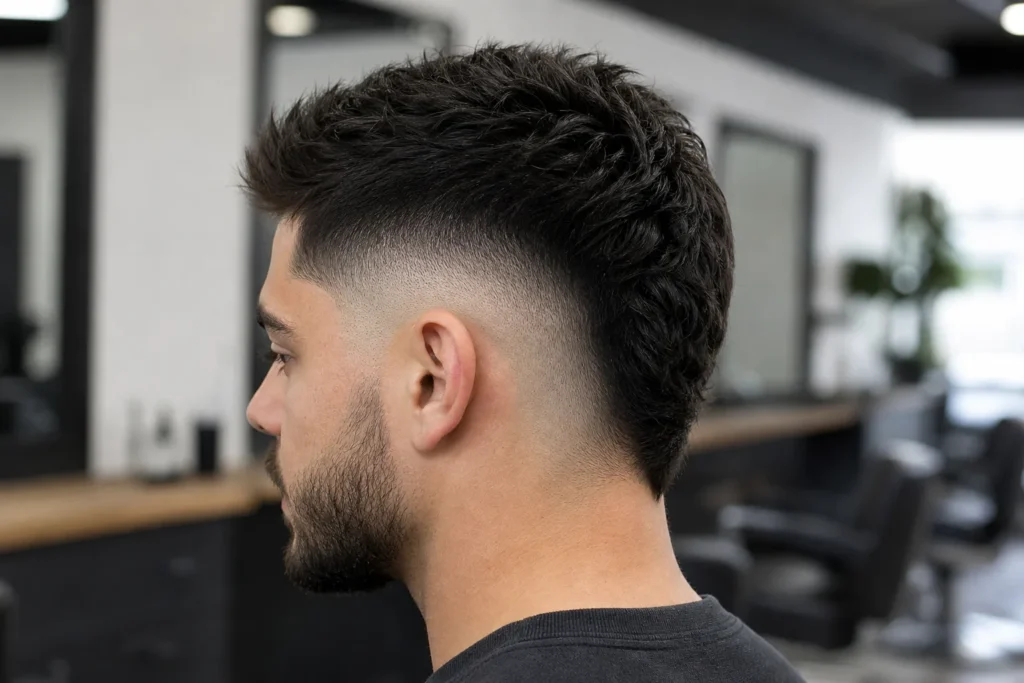
A burst fade is a rounded fade concentrated around the ear. The shortest area radiates in a semicircle, while more hair remains toward the back of the head. That retained back length separates it from a standard fade.
Burst fade vs drop fade
| Burst fade | Drop fade |
|---|---|
| Compact semicircle around the ear | Fade line curves down behind the ear and continues across the back |
| Often leaves a darker or longer back panel | Usually blends the nape as part of the fade |
| Common with mullets, mohawks and curly tops | Works with most top shapes |
Choose the finish
A skin burst fade creates the strongest outline around the ear. A zero, 0.5 or 1 leaves more hair, reduces scalp contrast and often grows out more smoothly. A low burst stays compact; a larger burst reaches farther toward the temple and back.
What to ask your barber
“I want a low burst fade around the ear, starting at a number 0.5. Keep the fade rounded and compact, and leave the hair behind the ear and at the back dark. Blend it into my textured top.”
If it is part of a mullet, also state exactly where the back should finish. Show a rear-side photo so the barber can see how much back panel to retain.
Who should choose it?
A burst fade is useful when you want a clean ear area but do not want a full fade across the back. It makes curls and a longer back look more deliberate. If you need a conservative, even silhouette for work or school, a low taper is less dramatic.
Maintenance
The curved edge loses definition as it grows, particularly with a skin base. Plan on two to four weeks between clean-ups. Ask the barber not to enlarge the burst at every visit; repeatedly moving the guideline outward can slowly remove the back section you intended to keep.
Recommended for this guide
Add matte texture and definition
As an Amazon Associate I earn from qualifying purchases. How affiliate links work