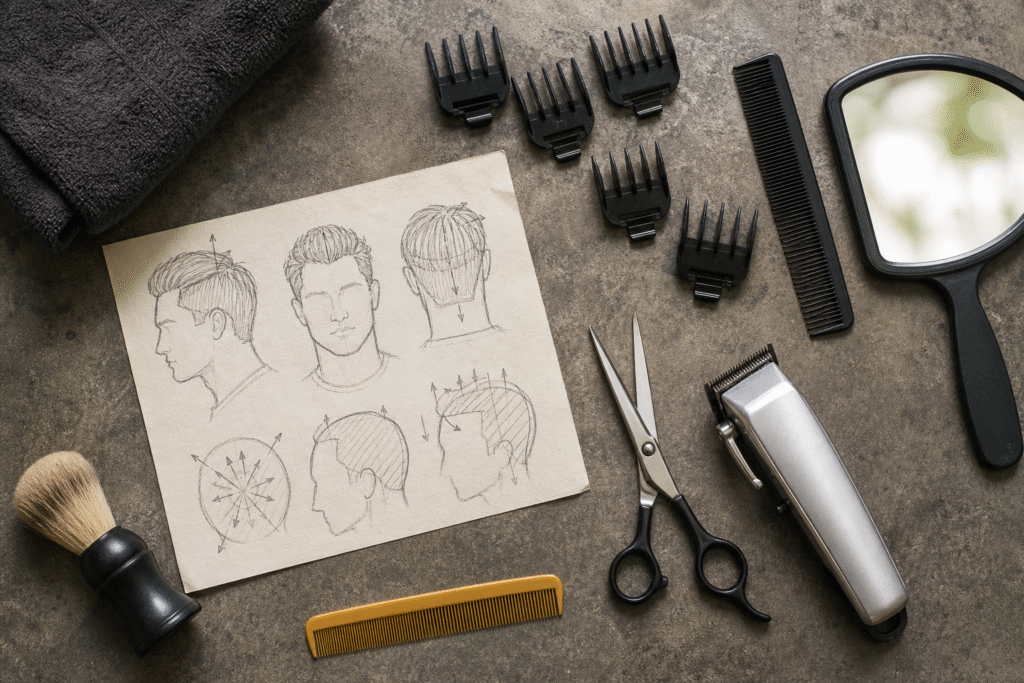
A fade is a gradual change from shorter hair near the base of the sides and back to longer hair above. The useful choices are where the transition starts, the shape it follows and how short the base becomes.
Choose the fade height first
| Type | Where the transition sits | What it changes |
|---|---|---|
| Low fade | Close to the ears and neckline | Keeps more darkness and weight on the sides; the least dramatic full fade. |
| Mid fade | Around the middle of the sides | Shows a clear contrast without removing as much side weight as a high fade. |
| High fade | Near the temples and upper sides | Creates the strongest contrast and makes the top look more separated. |
| Drop fade | Curves lower behind the ear | Follows the head shape and preserves extra weight at the back. |
| Burst fade | Forms a semicircle around the ear | Leaves more length behind the ear; often paired with a mullet or mohawk shape. |
Then choose the shortest length
- Skin or bald fade: the base is taken down to bare-looking skin with a foil shaver or razor.
- Zero fade: the base is normally cut with an unguarded clipper. It can look very close, but usually leaves fine stubble.
- Number 0.5 or 1: leaves more visible hair, feels softer and grows out less abruptly.
Height and shortest length are separate decisions. “Low skin fade” means a low transition with a skin-short base. “Mid number-one fade” means a mid transition whose shortest section is a number-one guard.
What to ask your barber
“I’d like a low fade, starting with a number 0.5 rather than skin. Keep some weight around the upper sides, blend it into the top, and leave about 5 cm on top with a textured finish.”
Replace the height, shortest length and top length with your choices. Show a front and side photo of the same haircut if the outline matters.
Which fade is easiest to live with?
A low fade starting at a 0.5 or 1 is forgiving as it grows. Skin fades show regrowth first and usually need edge-to-edge refreshing every two to three weeks. Mid and high skin fades can look noticeably softer after one to two weeks, even though the haircut is still tidy.
Before the cape goes on
- Agree on low, mid or high by pointing to the place where the shortest-to-longer transition should finish.
- Say “skin,” “zero,” or the guard number—do not rely on “short.”
- Decide whether the back should be straight, dropped or burst around the ear.
- Confirm how much length should remain on top in centimetres.
Recommended for this guide
Add matte texture and definition
As an Amazon Associate I earn from qualifying purchases. How affiliate links work