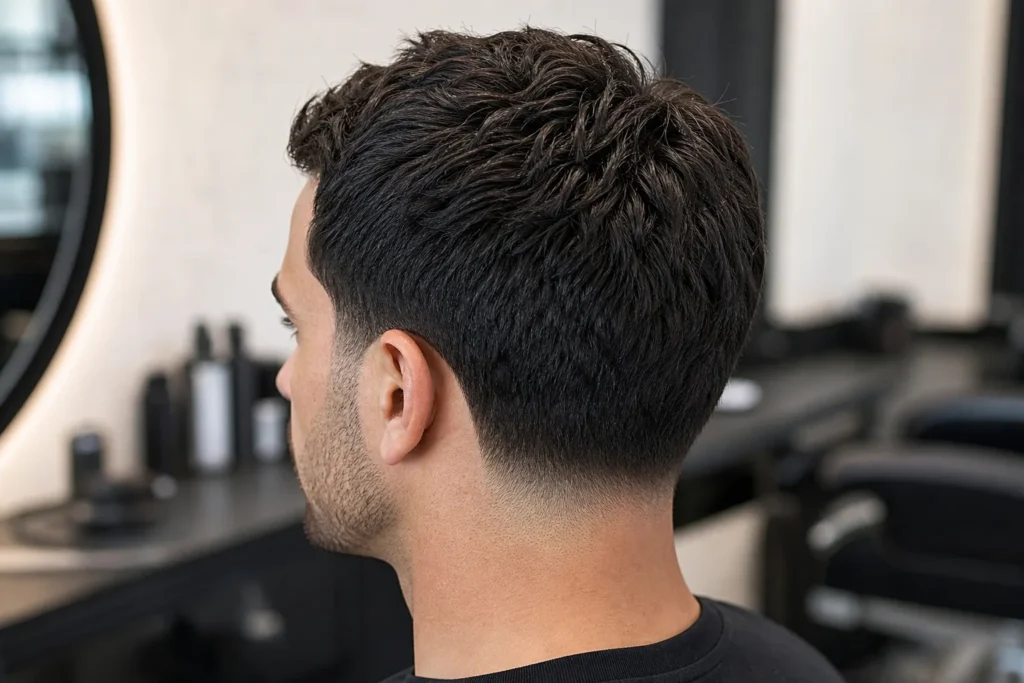
A low taper fade keeps the shortening close to the sideburns and neckline, leaving most of the sides full. In everyday barbering, “low taper” and “low taper fade” are often used for the same localised edge treatment.
Low taper vs low fade
| Low taper | Low fade |
|---|---|
| Shortens separate areas at the sideburn and nape | Creates a continuous short band around the sides and back |
| Keeps a dark, full side panel | Removes more lower-side weight |
| Subtle from the front and side | More obvious gradient |
| Usually softer grow-out | Short base becomes visible as it grows |
Pick the base length
- Skin: bare-looking edge and maximum contrast.
- Zero: unguarded clipper finish with fine stubble.
- 0.5 or 1: softer edge, less scalp exposure and easier grow-out.
What to ask your barber
“Low taper at the sideburns and neckline, down to a number 0.5. Keep the taper compact and leave the sides above the ear full. Do not turn it into a low fade around the whole head.”
Then specify the top separately: length in centimetres, fringe position and whether you want natural texture, curls or a smooth finish.
Works well with
A low taper can tidy curly hair without cutting away the side shape, clean the outline of a longer scissor cut, or soften the edges of a buzz cut. It is also a safer first step for someone unsure about a full fade: more can be removed during the appointment, but it cannot be put back.
Maintenance and skin comfort
A skin taper may need refreshing after two to three weeks. A 0.5 or 1 can remain tidy for three to five. If you get razor bumps, ask the barber to stop at a guarded length, avoid repeated passes and skip the foil shaver.
Recommended for this guide
Practical tools for straightforward buzz-cut upkeep
As an Amazon Associate I earn from qualifying purchases. How affiliate links work