Quick answer
The buzz cut has never carried one fixed meaning. Its clipper-short shape has represented military uniformity, practicality, athletic discipline, punishment, rebellion, gender freedom and personal reinvention in different settings. The wearer, the era and the people interpreting it matter more than the haircut alone.
First: a buzz cut is a family of haircuts
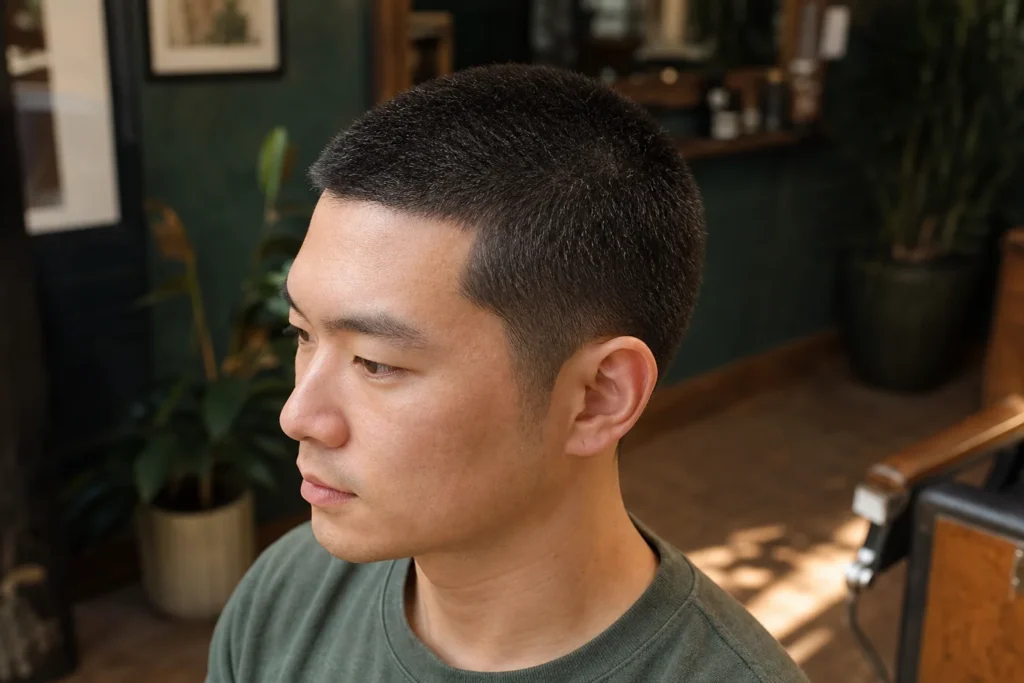
“Buzz cut” broadly describes hair cut very short with electric clippers. It is not one universal guard length or silhouette. A uniform one-length buzz, induction-style cut, burr, butch cut, crew cut and buzz cut with a fade can look and communicate very different things.
| Variation | Basic shape | What changes visually |
|---|---|---|
| One length all over | The same clipper setting across the head. | Simple, even and strongly exposes the natural head shape. |
| Induction-style | Extremely short and uniform. | Closest visual association with military intake and institutional uniformity. |
| Burr or butch | Uniformly short, with the butch generally retaining more length. | A little more coverage and softness than the shortest version. |
| Crew cut | Short sides with enough graduated length on top to shape. | More conventional structure and less of a shaved-head effect. |
| Buzz with a fade | Short top transitioning to shorter sides. | More contour, contrast and barbershop precision. |
That variety is important when discussing culture. A severe, uniform clip can signal something different from a carefully lined-up buzz with a skin fade, even though both are described with the same umbrella term.
Why is the buzz cut associated with the military?
Very short, standardised hair is practical in large institutions: it is quick to produce, easy to inspect, compatible with headgear and visibly reduces individual difference. Military induction made that transformation especially recognisable. A recruit could enter with a personal hairstyle and emerge looking like part of a unit.
That association continues even though modern military grooming rules are more detailed than “everyone gets a buzz cut” and differ by service, country, gender and period. Current regulations such as the US Army’s published grooming standards regulate neatness and safety while permitting multiple hairstyles. The cultural image of the induction cut is therefore stronger and simpler than the full reality of military hair.
Uniformity, control and belonging
Because hair is an accessible form of self-presentation, removing its length can communicate a reset of identity. In a voluntary group—a sporting team, fundraising event or friendship ritual—matching buzz cuts may express solidarity and belonging. When imposed by an institution, family or captor, the same physical act can represent discipline, loss of autonomy or humiliation.
Context changes the meaning completely. It is a mistake to celebrate the haircut as “fearless” in every case or to read every buzzed head as evidence of conformity. The most useful cultural interpretation asks who chose it, who had authority, and what the surrounding group understood it to mean.
How long hair made the buzz cut a counter-symbol
Hair meanings are relational. In periods when long hair on men became a sign of youth counterculture and rejection of conservative or military norms, a close-cropped head could read as establishment, discipline or traditional masculinity. Historical overviews of 1960s and 1970s style note how long hair became bound up with opposition to conventional expectations, including the military look.
Later subcultures complicated that contrast. Some groups adopted shaved or buzzed hair precisely because it looked confrontational, anti-fashion or stripped of middle-class polish. The same haircut could therefore be read as obedience in one setting and defiance in another.
Masculinity—and the limits of that reading
The buzz cut is frequently coded as masculine because of its military, sporting and manual-work associations and because it removes styling features traditionally marketed as feminine. It can suggest toughness, efficiency or indifference to grooming—even though a sharp line-up and fade may require frequent professional maintenance.
None of those qualities belongs to one gender. Treating a buzz cut as inherently masculine ignores the people who use it to challenge that exact assumption. Hair does not reveal someone’s gender identity, sexuality, politics or personality.
Buzz cuts, women and gender expression
On women and gender-diverse people, a buzz cut can attract more attention because it departs from the long-hair expectation that still shapes many beauty standards. For some wearers it feels freeing: less daily styling, less pressure to perform conventional femininity, or a clearer expression of an androgynous or queer identity. For others it is simply the haircut they like.
Public reactions often say as much about the observer as the wearer. Calling the cut automatically “brave”, “rebellious” or evidence of a crisis can turn an ordinary grooming choice into a stereotype. A better response is to let the person define what the change means to them.
Why the buzz cut is used as a visual reset
Film, television, music and celebrity coverage repeatedly use head shaving as shorthand for transformation. It is visually immediate: the before-and-after image is unmistakable, and hair that took months or years to grow disappears in minutes. Stories use that change to mark enlistment, imprisonment, illness, grief, rebellion or a new beginning.
Real people may choose a buzz cut after a breakup, before travel, during hair loss, for fundraising, for sensory comfort or simply out of curiosity. The “fresh start” feeling can be genuine without proving that the wearer is unstable or making a dramatic statement. Sometimes a practical haircut is only practical.
Sport, work and practical appeal
Short hair can be convenient around helmets, heat, sweat and demanding schedules. That helps explain its recurring place in sport and physical work. It also makes the cut popular with people who want to reduce drying and styling time.
“Low maintenance” needs one qualification. A uniform buzz is straightforward to wash and can be clipped at home, but a crisp fade, sharp line-up or exact all-over length shows regrowth quickly. The daily routine may be minimal while the haircut schedule is frequent.
Hair loss, illness and unwanted assumptions
Some people buzz their hair to make thinning less visually uneven, to prepare for medical treatment, or because scalp and hair care have become difficult. Others do not. A short cut is not permission to ask about someone’s health or touch their head.
This is another reason the haircut cannot be decoded without context. The wearer may be managing a private change, making a public statement, or doing neither.
What a buzz cut communicates today
| Possible reading | Why people make it | Why it may be wrong |
|---|---|---|
| Disciplined or uniform | Military and team associations. | The wearer may have chosen it for comfort or style. |
| Rebellious | It rejects mainstream hair expectations in some settings. | In another setting it may be the most conventional cut available. |
| Masculine | Longstanding military and sporting imagery. | People of every gender wear it, often to resist gendered expectations. |
| Low maintenance | Little washing, drying or styling is required. | Fades and line-ups can need frequent upkeep. |
| A fresh start | The physical transformation is immediate. | It may have no deeper personal meaning at all. |
These readings can coexist. Culture supplies a set of associations, not a reliable biography of the person wearing the cut.
Choosing a buzz cut without losing the result you want
If the culture interests you but you are deciding whether to get the cut, focus first on the physical result. Very short hair reveals more of the natural head shape, hairline, scars, cowlicks and differences in density. Ask a barber to assess those features before choosing a guard.
A useful barber request
“I want a buzz cut like this photo. Please leave the top at [chosen visible length], with [the same length / a low, mid or high fade] on the sides. Keep the front hairline [natural / lightly edged / sharp]. Before going shorter, show me how much scalp is visible at the first setting.”
Guard numbers can vary between tools and do not tell the barber the whole shape. A photo plus a conversation about length, fade height and hairline is more dependable. For the cutting and maintenance details, read our practical buzz cut guide.
Questions people ask about buzz-cut culture
Does a buzz cut mean someone is in the military?
No. The military association is culturally strong, but the cut is common in civilian life, sport, fashion and many subcultures.
Is a buzz cut a political statement?
It can be, but usually cannot be interpreted reliably on appearance alone. Different and even opposing groups have used close-cropped hair. Do not infer a person’s beliefs from the haircut.
Why do people buzz their hair after a major life event?
The fast, visible change can make a new phase feel concrete and can remove an old styling routine. That explanation fits some people, not everyone.
Can a buzz cut be professional?
In many workplaces, yes. Expectations still vary by employer, industry and local policy. A neat outline and deliberate length may be read differently from an uneven home clip, but “professional” standards are cultural rules rather than properties of the haircut itself.
Where can I find a barber for a buzz cut or fade?
Check recent portfolio examples for the exact finish you want, especially if you want a skin fade or precise line-up. Use the Barber.Style Australian directory to compare nearby shops, hours and contact options.
Editorial note: This article discusses changing cultural associations rather than assigning motives to individual wearers. It was substantially rewritten and reviewed for clarity in July 2026.
Recommended for this guide
Practical tools for straightforward buzz-cut upkeep
As an Amazon Associate I earn from qualifying purchases. How affiliate links work