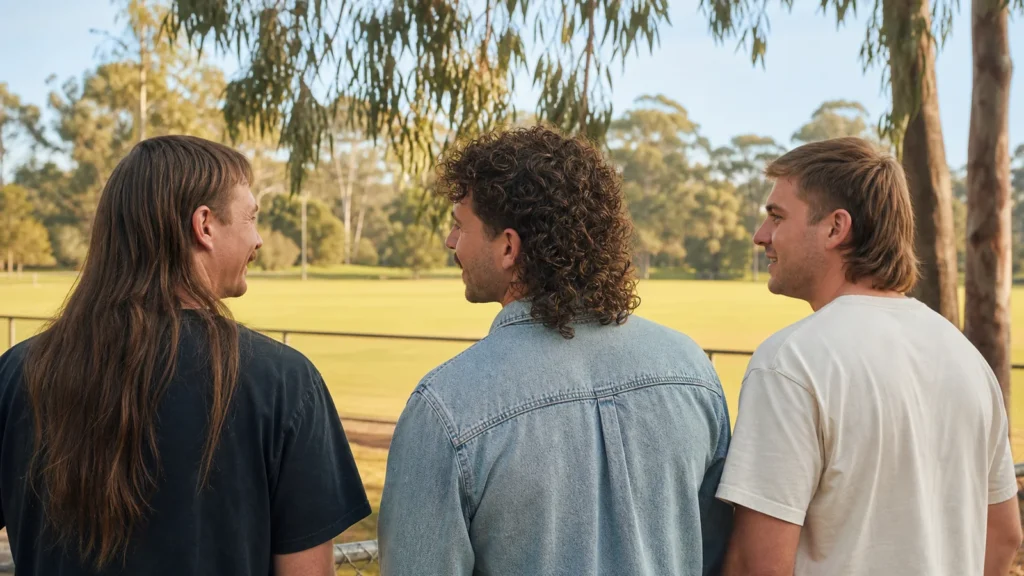
The hairstyle is much older than the name “mullet.” Shorter hair around the front and sides with length at the back has appeared in different periods and cultures, but the modern English haircut name became widespread in the 1990s.
Where did the word come from?
The Oxford English Dictionary credits the Beastie Boys’ 1994 song “Mullet Head” and the group’s magazine writing with popularising the haircut term. That is evidence for the name’s modern use—not proof that they invented the hairstyle.
A short timeline
- Ancient references: art and written descriptions show practical hair shapes with protection at the neck in several societies. These are predecessors in shape, not necessarily “mullets” in the modern cultural sense.
- 1970s: glam and rock performers made deliberately androgynous, theatrical short-front/long-back shapes highly visible. David Bowie’s red Ziggy Stardust-era hair is one famous example.
- 1980s: versions spread through rock, pop, television and professional sport, often with large volume and strong disconnection.
- 1990s: the name “mullet” took hold as the style became a frequent target of humour and class stereotypes.
- 2010s–2020s: the cut returned through fashion, music, queer expression, sport and DIY haircut culture, usually with softer layers or a burst fade.
Why the mullet matters in Australia
In Australia the mullet is unusually visible across sport, regional identity, festivals and everyday barbering. It can signal humour and refusal to look polished, but it is not owned by one group. Footballers, musicians, children, fashion clients and people wearing it as a practical low-maintenance cut all change its meaning.
“Business in the front, party in the back”
The phrase survives because it describes the visual contrast neatly, but it is a slogan rather than a technical definition. A contemporary mullet may be textured and long at the front too; it still reads as a mullet when the back remains deliberately longer than the sides.
Recognising related cuts
A shag usually carries connected layers around the whole head. A mohawk centres length in a strip from front to back with much shorter sides. A wolf cut is heavily layered with volume near the crown. These categories overlap, so a haircut can reasonably be described as a mullet-shag or burst-fade mullet.
Recommended for this guide
Add matte texture and definition
As an Amazon Associate I earn from qualifying purchases. How affiliate links work